ConstructionOnline Blog

Caroline Smith

Caroline Smith

Recent Posts by Caroline Smith:

7 Ways to Improve Construction Estimate Spreadsheets (Free Templates)

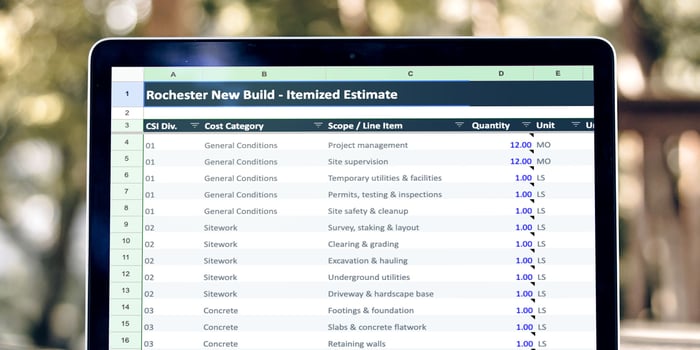
A construction estimate helps you turn project scope into a working budget. Before work begins, it brings expected costs into focus so your team can prepare bids, plan resources, and evaluate whether the job is financially viable.

For contractors who estimate in Excel or Google Sheets, a well-organized spreadsheet can provide a practical, low-cost starting point. Reusable templates help standardize estimates, while built-in formulas reduce repetitive calculations. But outdated costs, overwritten formulas, and inconsistent data entry can make even a familiar spreadsheet difficult to trust.

The following seven improvements can help you organize estimate details, reduce common spreadsheet errors, and make your estimates easier to review and update. You’ll also find free construction estimate templates to help you put these practices to work.


Read More...

Submittals vs Transmittals vs RFIs: A Plain-English Breakdown

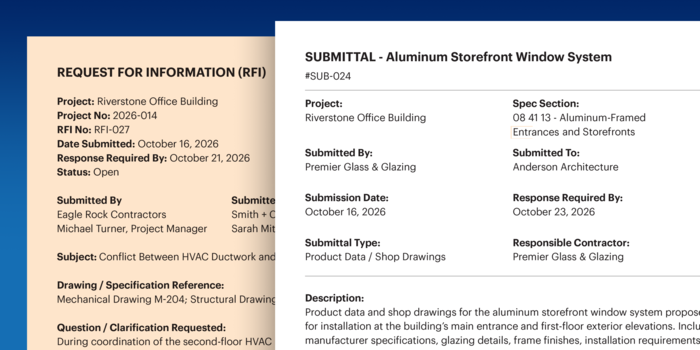
Submittals, transmittals, and RFIs all move critical project information from one party to another—but they serve very different purposes.

A submittal sends materials, products, or project information for review. A transmittal documents what was sent, when, and to whom. An RFI asks for clarification when drawings, specifications, or other project documents leave a question unanswered.

Understanding the difference matters because each one creates a different record, triggers a different workflow, and helps prevent a different kind of project risk.

Here’s how each document works, when to use it, and how the three fit together on a construction project.

Read More...

Construction Job Costing: An Essential Guide for Contractors & Builders

When it comes to construction project management, the estimate only tells a small part of the financial story. What affects your profits is the actual costs incurred as the project progresses.

This complete guide will walk you through the ins and outs of construction job costing, including the crucial role it plays in protecting profits, the hidden job costing errors that erode margins, and best practices for implementing accurate job costing.

Read More...
Topics: Estimating Job Costing

Why ConstructionOnline Is the Straightforward CoConstruct Alternative

In its prime, CoConstruct was a project management platform suited for residential custom home builders and remodelers who needed a simple, streamlined way of managing all aspects of construction projects.

ConstructionOnline is an all-in-one construction management platform from UDA Technologies, a leader in the construction software industry since 1999. With tailored solutions for residential builders, commercial construction firms, specialty contractors, and multifamily developers, ConstructionOnline offers integrated, award-winning tools for construction financial management, project coordination, documentation, communication, and reporting in one system.

Following the 2021 Buildertrend acquisition of CoConstruct, the future of that platform has been murky at best for the user base—until recently. Now, the timeline is clear, and the pressure is real, leaving many CoConstruct users asking themselves...where do we go from here?

According to the official CoConstruct-to-Buildertrend migration timeline, the creation of new projects in CoConstruct will only be available through March 31, 2027. Factor in the 3-4 months Buildertrend's own transition plan allots for onboarding and training before new projects move exclusively to their platform, and you're looking at needing to know your next steps by the end of 2026.

Buildertrend may be positioned as the default next step, but it isn't the only option available. CoConstruct users who have resisted the push to migrate thus far likely have valid reasons for resisting.

The good news is that right now, CoConstruct users still have time to evaluate which platform best preserves the residential workflows their teams depend on, from estimating and selections to scheduling, job costing, and client communication.

In this article, we'll look at why ConstructionOnline may be the most straightforward CoConstruct alternative for residential builders and remodelers seeking familiar workflows, a complete feature set, and support throughout the transition.

Read More...
Topics: Competitor Comparison

Construction Safety Management: Building Safer, Lower-Risk Jobsites {Free Template}

According to the National Safety Council: Injury Facts, the construction industry has consistently been rated one of the most dangerous industries based on number of fatalities, nonfatal total recordable incidents (TRI) and nonfatal days away from work (DAFW).

As a construction professional, you don’t need stats and studies to understand why this is the case. You see the risks in the field every day: the heavy machinery, the lifting and digging, fall hazards, head injuries, and more. It can be daunting to manage, yet effective safety management is one of the cornerstones of running a successful construction business.

Construction safety management is the process of establishing, implementing, monitoring, and improving the policies and procedures used to identify hazards and protect workers across jobsites. In this article, we’ll explore how construction professionals can implement construction safety management processes that lower risk, protect profits, and keep your team as safe as possible despite the inherent risks that come with the job.

Read More...

4 CoConstruct Alternatives for Residential Builders & Remodelers in 2026

It’s no secret that the long-awaited CoConstruct phaseout is nearing the final stage of its lifetime.

In 2021, CoConstruct was acquired by Buildertrend. In 2024, they stopped all new sales of CoConstruct as well as product development.

And recently, it was announced that anyone still using CoConstruct will be forced to migrate to Buildertrend in 2027; all new project creation in Coconstruct will be suspended after March 31, 2027 in preparation for the required migration.

That means there’s not much time left to prepare your business for the inevitable if you haven’t made the switch yet. But with this forced migration comes many unanswered questions and valid concerns for CoConstruct users: Is Buildertrend really the best option for my business? Are there better alternatives to Buildertrend out there that I don’t know about? What metrics should I use to determine the best project management software alternative to the CoConstruct-Buildertrend migration?

There’s so much information out there but it’s not always as understandable as it should be. In this article, we’ll provide a factual, comprehensive comparison of 4 similar or better alternatives to Buildertrend and CoConstruct and we’ll answer all the frequently asked questions about the migration process, including what it entails and how to make it as seamless as possible.

Read More...
Topics: Construction Operations Management Construction Operations

7 Operational Warning Signs Every Construction Leader Should Watch For

Business is doing fine for now. Or so it seems. But surface level success doesn’t always tell the full story.

Projects are moving, subs are showing up, and profit is coming in. But somewhere underneath all that, margin is leaking in places that never show up on a report.

If nothing looks “broken” right now, how are you supposed to know what needs fixing, or that anything needs fixing at all? Whether you notice them or not, the signs are there. They don’t always present as loud, blaring sirens. Many times, they’re silent and go unnoticed until it’s too late; a few overdue tasks that put the whole project behind schedule; a handful of change orders that end up going thousands of dollars over budget; all of those minor things that slip through the cracks add up to major margin erosion.

In this article, you’ll learn the clear and not-so-clear warning signs that operational dysfunction is happening in your construction business, and the practical ways to act on those signs before they lead to even more dysfunction and profit loss.

Read More...
Topics: Construction Operations Management Construction Operations

Managing Subcontractors Across Projects That Don’t Look Alike


Every construction project is not created equal. That’s true for many different aspects of construction management, but particularly when it comes to subcontractor coordination.

For each individual project you manage, there are different specs, owners, schedules, and reporting requirements, and that variability compounds across active jobs. When subcontractors are inefficiently managed from project to project, your construction business will experience coordination breakdowns that set projects back and ultimately tighten your profit margins.

Subcontractors don’t work in a vacuum; it’s a coordinated effort. Subs are often relying on each other’s ability to get their tasks done in a timely manner, and when that doesn’t happen, project performance suffers greatly. The right subs need to see the right information at the right time, but achieving that reality is where many construction managers are falling behind. The answer lies in one crucial element.

The key to effectively managing subs and team members across different construction projects is operational visibility: that means as the project manager, you need the ability to track and manage different subs, specs, owners, and schedules while allowing your subs to view their respective responsibilities. This ensures your team is connected, on-time, on-task, and running efficiently.

In this article, you’ll learn why visibility in construction operations is crucial for successful sub management in today’s market, the common breakdowns that occur when visibility is lacking, and practical ways to build operational visibility into your business.

Read More...
Topics: Construction Operations Management Construction Operations

Why Connected Construction Operations Outperform Bigger Ones

The industry is experiencing a quiet shift in how the most profitable construction companies think about growth. It's less about how much new work you're winning and more about keeping the margin on the work you already have.

The conventional wisdom in construction has long been that growth means winning more work. But in today's market, where margins are getting squeezed from every direction, the companies pulling ahead aren't necessarily the ones building more. They're the ones losing less on what they build.

You are looking to win more work; you're looking for connectivity. Operations where field and office aren't running on different information. Where commitments made on a Tuesday walkthrough don't disappear before Thursday's billing cycle. Where the small breakdowns that quietly erode margin get caught while there's still time to do something about them.

This article, along with others in this series, makes the case for what connected operations actually get you in today's market: better margin protection, sharper execution, and the kind of operational visibility that lets you stay ahead of problems instead of cleaning up behind them.

Read More...
Topics: Construction Operations Management Construction Operations

What Makes ConstructionOnline Estimating #1 in the Industry?

Choosing construction estimating software can mean the difference between your business making more money and soaring above the competition, or hurting your bottom line and losing clients. Why? Because estimating creates the financial foundation on which your project is executed.

In our last two articles, we looked at the mistakes that derail construction estimates and the importance of building an estimating process that scales. Now, let's talk about construction estimating software that sets you up for success on all fronts: ConstructionOnline.

This article breaks down why ConstructionOnline — and our industry-leading OnCost Estimating software — outperforms the competition for your construction business.


Read More...
Topics: Estimating Financials