
When it comes to construction project management, the estimate only tells a small part of the financial story. What affects your profits is the actual costs incurred as the project progresses.
This complete guide will walk you through the ins and outs of construction job costing, including the crucial role it plays in protecting profits, the hidden job costing errors that erode margins, and best practices for implementing accurate job costing.
What Is Job Costing?
Construction job costing is the process of tracking the costs associated with a specific job rather than the entire business, including labor, material, and overhead expenses. Construction companies use job costing data to accurately measure profits for a specific project.
In its most simple form, job costs can be calculated using this basic formula:
Total Job Cost = Materials + Labor + Overhead
Job Costing vs. Estimating
Estimating and job costing look at the same project finances, but from two different perspectives. Construction estimating calculates the direct and indirect costs you expect a job to require before work begins. Job costing tracks the actual costs incurred throughout the project.
Interested in learning more about crafting accurate construction estimates? Read more:
Need some help getting started? Download our free Construction Estimate templates—customizable construction estimating spreadsheets that include built-in formulas, categories, and subcategories to support detailed, well-organized, accurate estimates on every job.

The Importance of Job Costing
Job costing in construction projects enables you to track how every dollar is being spent so you can stay under budget and protect your margins.
Once work begins, actual project conditions rarely align perfectly with your carefully crafted estimate. Material price changes, labor overruns, change orders, delays, and other variables can all alter the final cost of the job. When job costing is an ongoing part of active project management, you have visibility into those changes while there is still time to respond.
Good job costing protects your profits and your business:
- Compares estimated costs against actual project expenditures
- Shows where and when the project moves away from the budget
- Allows you to catch potential financial cost overages early so you can adjust accordingly
Bad job costing squeezes profit margins and puts your business at risk:
- Causes a disconnect between estimated vs. actual costs
- Leaves room for budget-altering tasks and incidents to go unnoticed until it’s too late
- Leads to your business absorbing costs it shouldn’t have to
Implementing an effective job costing process in your construction operations means budget changes won’t catch you off guard, which equips you to make profit-protecting decisions in real-time. And poor job costing leads to costly results that affect your bottom line. That’s why job costing is so crucial for project managers.
But effective job costing is not always so simple and straightforward without the right systems and processes in place. Accurate job costing depends on more than just an accounting formula; it depends on having reliable project information consistently flowing into that formula.
Where Job Costing Goes Wrong According to the Data
When it comes to job costing, some project costs are relatively easy to identify and track: materials, equipment, labor, subcontractor expenses, and allocated overhead. Those are concrete numbers that you can plug into formulas and calculate without too much thought.
But direct expenses aren't the only factors that affect the final cost of a job. Operational breakdowns can create additional costs through rework, delays, errors, and lost productivity—creating cost increases that are hidden in plain sight.
Here are some common construction management mistakes that increase job costs unnecessarily:
-
Poor documentation and bad data that leads to poor decision-making and rework
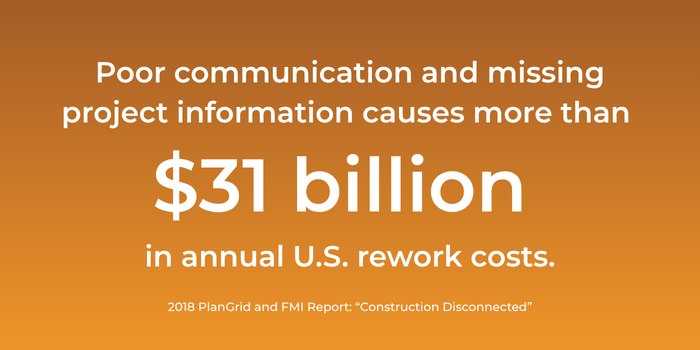
In a report of 2,000 respondents conducted by Revizto, it was found that rework costs the global construction industry upwards of $625 billion a year. Also, a review of the complete "Construction Disconnected" report from 2018 that's cited as this blog's source has found that 52% of all rework globally is caused by poor data and miscommunication" (page 7 of the report PDF).
The top 3 cited reasons for rework in the Revitzo study included:
-
- 47% change orders, client changes, and scope creep
- 42% design errors and incomplete plans
- 41% poor communication and coordination
-
Lack of centralized data management
Findings from an Autodesk and FMI study suggest that bad data costs the global construction industry $1.85 trillion a year. More specifically, $88.69 billion of that amount is attributed to rework alone. The findings reinforce teams and organizations that lack a structured data management environment where they can consistently access relevant, accurate and complete information are at risk of more rework and shrinking margins.
-
Small errors and minor miscalculations that compound over time
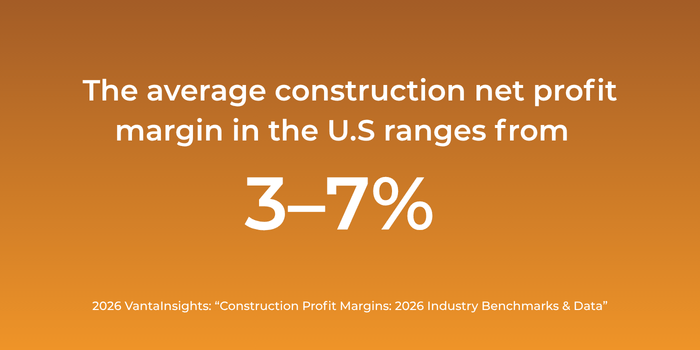
According to analysis from VantaInsights, the average construction net profit margin in the U.S ranges from 3–7%. Those are already very thin margin margins, which leaves construction businesses with very little room for error when costs rise. Such low margins mean that multiple seemingly small mistakes can quickly add up, eroding already-thin margins—or even eliminating them entirely.
These costs can be harder to identify because their root causes are woven into the day-to-day operations of your construction business. Rework, for example, may appear as additional labor and material expense on the books, while the underlying cause—poor communication, outdated information, or undocumented changes—won't appear as a line item on your ledger or job-cost reports.
As the data above illustrates, these operational gaps can quietly erode the margins you're trying to protect. This is deeper than the material, labor, and overhead costs that are easily definable; this is an issue within the foundation of your business operations.
The Bottom Line: Accurate Job Costing Starts with Strong Operations
Accurate job costing may start with labor, materials, equipment, subcontractor costs, and overhead, but the processes behind those numbers matter just as much. Disconnected or inefficient operations can create additional expenses through rework, delays, errors, and lost productivity. You could call it an operational tax: the additional fee you unknowingly pay each time an operational failure occurs.
Here’s how inefficient construction operations increase costs and stifle profitability:
- Overlooked or lost information slips through the cracks and causes confusion, missed deadlines, and ultimately rework that costs money
- Unnecessary mistakes and miscalculations don’t seem so costly on their own, but end up compounding into more expenses
- Preventable schedule conflicts and communication errors cause avoidable delays and lengthened timelines–which add up to more costs
- A lack of visibility among subs and team members means fewer people know what their responsibilities are and when they’re due
Those operational breakdowns eventually surface as real projects costs:
- An unrecorded change order means completed work may never be properly billed or reflected in the budget.
- An unanswered RFI can delay work or lead teams to proceed using incomplete information.
- A missed subcontractor start date can push dependent activities back and extend the project timeline.
What the "Operational Tax" Looks Like on an Actual Job
Here’s a hypothetical scenario demonstrating the ‘operational tax’ a construction business can pay when preventable mistakes occur in day-to-day operations:
Total Job Cost = Materials + Labor + Overhead
Let’s use the basic job-cost formula for a bathroom renovation project:
Suppose the project is estimated to require $4,000 in materials, $10,000 in labor, and $2,000 in allocated overhead. That gives the project an estimated total job cost of $16,000.
That $16,000 reflects the project as planned. But once work begins, operational breakdowns can introduce costs that weren’t part of the original budget: operational taxes.
|
Materials |
$4,000 |
|
Labor |
$10,000 |
|
Overhead |
$2,000 |
|
Total Job Cost |
$16,000 |
Midway through the project, the client requests different fixtures. The upgraded materials should add $1,400 in costs to the project budget through a documented change order. But the superintendent on-site that day green-lighted the installation with a handshake instead of proper documentation, leaving the project's running budget and billing instantly out of sync. This expense that should have been accounted for and recovered through the change order instead is absorbed by the company.
Later that week, the plumber arrives on-site but can't proceed because the updated fixture specifications never made it to him. He loses half a day waiting for clarification and has to return the next morning, adding another $600 in avoidable labor and scheduling costs.
Individually, neither breakdown may seem catastrophic. Together, they leave the company absorbing $2,000 beyond the project's original planned cost—an amount equal to 12.5% of the original $16,000 estimate.
|
Planned Job Cost |
$16,000 |
|
Change Order & Schedule Conflict Fees (Operational Tax) |
$2,000 |
|
Actual Job Cost |
$18,000 |
That extra $2,000 is the ‘operational tax’: an expenditure the company didn't plan for, but absorbed because disconnected information, poor documentation, and miscommunication allowed preventable costs to accumulate.
A few instances such as this that deviate from the original plan can turn a healthy 5% profit margin into a 3% margin.
Case Study: How Operational Efficiency Increases ROI
Although these operational taxes and job-cost factors can be difficult to track, it’s not impossible to put the ROI of fixing those breakdowns into tangible numbers. October 5 Fine Home Builders offers one example. After replacing disconnected spreadsheets with ConstructionOnline, owner Jim Brophy reported impressive returns.
- 10 hours saved on average every week
- $117,000 saved in a year
- 97.5% of the documented savings retained as profit
ROI of PM Software That Improves Operational Efficiency:
 10hrs
10hrs
Using ConstructionOnline saves Jim ~10 hours a week
 117k
117k
Using ConstructionOnline saves Jim about $117,000 a year
97.5%
Jim directly pockets 97.5% (over $100,000) of that money saved
Operational breakdowns have real financial consequences, and fragmented systems make those costs harder to identify and control.
Best Practices for Job Costing
Once you understand where job costing typically breaks down, protecting your margins comes down to building habits that catch problems while there's still time to act. Here's where to start:
- Break your budget into detailed cost codes. Instead of tracking materials, labor, and overhead as three lump sums, break each category down by trade, phase, or task. That level of detail reveals exactly where a job is overrunning instead of leaving you to hunt for it after the fact.
- Update job costs continuously, not just at closeout. Job costing loses most of its value when it's treated as a once-a-month or end-of-project exercise. Recording costs as they're incurred—materials delivered, hours logged, subcontractor invoices received—means you can catch a budget-altering issue while there's still room to adjust.
- Document every change order as soon as it occurs. A change order that isn't logged and tied to the right cost code is functionally invisible to your job costing, even after the work is done and paid for. Capture change orders in writing and view the cost impact on your budget as soon as they're approved, not after the walkthrough or at billing time.
- Compare estimated vs. actual costs regularly. Set a recurring checkpoint to compare your running actuals against the original estimate. This could be weekly or biweekly, depending on the project. Consistent tracking is what turns job costing from a lagging report into an early warning system.
- Standardize how field issues are communicated. RFIs, spec changes, and scheduling conflicts should follow the same documentation path every time, regardless of which sub or crew is involved. When communication is ad hoc, those issues are far more likely to become the kind of operational tax your business absorbs.
- Close the loop with a post-project cost review. Once a project wraps, compare your final job costs against the original estimate and pin down where the two diverged and why. Learning from historical data can prevent you from repeating the same costly mistakes on future projects, so feed those lessons back into your estimating process.
Most of these practices point to the same underlying need: a single, reliable source of truth for project costs that everyone on the team—field, office, and accounting—can see and update in real time.

Turning the Tide: Making Better Decisions with Job Costing Data
If the job costing data shows money is being lost due to disconnected workflows like disjointed financial data, communication breakdowns, and poor collaboration, contractors can address those problems with an integrated system that centralizes all aspects of project management.
In a recent report by Dodge Construction Network, construction professionals who adopted project management software reported major benefits in their business operations:
- More than 50% of contractors experience improved communication and collaboration.
- 90% agree the software has enabled their teams to manage more capital projects.
- 76% report that project delays are reduced by 5 days or more on average.
- More than half of contractors see improved productivity and operational efficiency.
The data is clear: connected construction operations have the significant advantage. That explains why 61% of construction companies are prioritizing integrated and full-scale digital solutions like PM software that connects design, procurement, and execution. Contractors and builders need systems that turn fragmented processes into connected workflows where teams can access accurate project information in real time.
In other words, construction projects are only as efficient as the operations and technology that fuel them. Inefficient technology and disconnected workflows make it harder to control costs, maintain productivity, and protect margins.
The cost of managing projects through long email threads and dozens of disconnected spreadsheets has become increasingly difficult to sustain.
Here’s how an integrated digital platform can keep job costs reasonable and protect your profits:
- Faster, better-informed decision-making because you can access all the relevant information you need when you need it
- Less rework because you’re not working from incomplete or incorrect data
- Improved collaboration with subcontractors and other stakeholders that keeps schedules moving and prevents schedule conflicts
- Clear communication with clients that keeps approvals, selections, and changes documented and visible
- Stronger margin protection by reducing the costly errors and inefficiencies associated with fragmented systems
Contractors today are managing projects against thin margins, elevated costs, and increasingly complex streams of project data. Accurate job costing gives teams the visibility to understand where money is going, identify problems earlier, and make better-informed decisions before those problems eat into profitability. When job-cost data lives alongside estimating, scheduling, change orders, communication, and other project information, those decisions become easier to make in real time.
ConstructionOnline brings financial tracking, project management, communication, and reporting together in one connected platform—giving contractors the visibility they need to control costs and protect project profitability.
See how ConstructionOnline can help you build a more connected, cost-conscious operation.