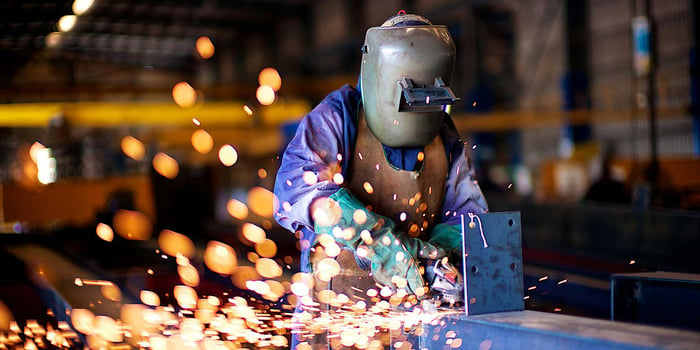
For years, the message to young people was consistent: go to school, get a degree (maybe two), and land a desk job.
That was the version of stability they were sold (and borrowed against). Construction watched from the sidelines as an entire generation followed it.
The debt arrived on schedule, but the stability didn't.
So now they're looking at the trades.
Why the Construction Labor Shortage Isn't Going Away
The current moment is complicated. Contractors have been holding their positions, waiting on tariffs and economic uncertainty to work themselves out. ABC's chief economist described it as "an utter lack of churn." But that same organization's January forecast projected the industry would need 349,000 additional workers this year, rising to 456,000 in 2027. Most of that demand isn't coming from growth, but from retirements.
A slow quarter and a structural workforce shortage are two different problems, and only one of them resolves when the uncertainty does.
Gen Z Is Turning to Skilled Trades in Construction
More people are looking at the trades for reasons that have less to do with construction itself and more to do with what's happening elsewhere.
Research from SupplyHouse found that three-quarters of Gen Z now associate desk jobs with burnout and instability. They watched the path play out in real time, and it didn't deliver what it promised. Then AI arrived, and even the entry-level office jobs that once looked stable started feeling far less secure.
That same technology is driving what McKinsey estimates could reach $7 trillion in global data center investment by 2030. Those facilities don't build themselves. Somebody's got to wire them together, which gets interesting when approximately one in five electricians is already over the age of 55 and nearing the end of their careers.
The technology creating the demand is the same one disrupting the workforce expected to meet it.
A job title can be eliminated in a memo. A trade skill goes where you go.
Seventy-eight percent of Gen Z now see skilled trades as less vulnerable to AI disruption than white-collar careers. The Bureau of Labor Statistics reported median annual wages for construction and extraction occupations higher than the median for all occupations. Gen Z is noticing. Nearly one in four are seriously considering or already pursuing a career in the trades.
For years, the industry tried to recruit its way out of the problem. Then the world outside construction did it for them. That's not a strategy, and windows like this don't tend to stay open for long.
If you're a contractor, that means this: the next person who walks onto your jobsite looking to build a career in the trades may be easier to find than they were five years ago. What they find when they get there is still entirely up to you.
Why Hiring Alone Won't Solve the Construction Labor Shortage
Getting someone on site is one thing. Keeping them is another. For a generation that came to the trades looking for work that actually means something, what they walk into on day one carries more weight than it used to. For a lot of them, the crew they land on is what decides whether they stay.
Think about how your company promotes people into leadership. Chances are the best superintendent you have was the best foreman before that—and the best foreman was the best craftsman before that. That model held when the bench was deep and people stayed for thirty years. With roughly 40 percent of the construction workforce projected to retire in the next five years, it's showing its limits.
The industry is in a holding pattern right now, but that's also an opening. The companies that come out on the other side with functioning crews won't just be the ones that hired when demand returned, but the ones that used this window well.
Pay matters less than you'd think. The new hires who actually stay are usually the ones who found someone worth learning from. Those who leave in their first year aren't always leaving the trade, just the job they landed.
The labor shortage isn't something a contractor can solve alone, but what happens on your jobsite is.
Construction Labor Shortage and Worker Retention on the Jobsite
The environment a new worker walks into shapes whether they stay. A jobsite where someone can get their bearings on day one creates room for something much harder to build: the relationships and experience that actually keep people around.
That doesn't happen when your foreman is spending the first week of every job fielding the same questions and tracking down missing documents.
ConstructionOnline is built for that clarity. Not to replace the judgment it takes to develop someone, but to clear the path for it to happen. A foreman who isn't managing confusion can actually manage people. A new worker who isn't spending their time piecing things together has something to learn from instead of something to work around.
That's the kind of jobsite experienced people retire out of. The companies that built it before the retirements hit are the ones that will still have functioning crews on the other side.
What Happens Next for the Construction Labor Shortage
The shift bringing Gen Z into the trades won't hold forever. The industry has already seen how quickly the picture can change. Economic conditions shift. If white-collar work stabilizes or AI pivots in a direction nobody predicted (wouldn't be the first time), the moment passes. And when it does, the industry is back to fighting for workers.
You can't predict the labor market, but you can decide what your jobsite looks like when someone new arrives.