
Labor is one of the largest costs on any construction project—often 30% to 50% of total project cost for self-performed work, and for some trades and contract types, more. It's also one of the costs most likely to be wrong in the estimate, for a simple reason: the number most builders carry for labor isn't the number labor actually costs.
Materials get quoted. Subs get bid. But self-performed labor gets estimated with the number that's easiest to grab—the wage rate—and the wage rate is only part of the story. The rest shows up in payroll, quietly, on every job, whether the bid accounted for it or not.
This article covers what construction labor costs actually include, how to calculate a fully burdened labor rate you can trust in a bid, and—because percentages on a page never quite land the way a real job does—what the gap looks like on one crew, over one ordinary week.
Self-Performed Labor vs. Subcontracted Labor
Before the math, here's a distinction that determines whether any of this math is yours to do: self-performed labor is work done by your own employees, while subcontracted labor is work done by another company's crew under a bid or contract. The two behave completely differently in job costing.
Subcontracted Labor
If you subcontract a trade, the sub's invoice is your labor cost for that trade—subcontracted labor doesn't carry burden calculations on your side of the ledger. Payroll taxes, workers' comp, insurance, benefits—all of it is the sub's responsibility, baked into their price.
From a job costing perspective, subcontracted labor behaves like a material: you're buying a finished scope at a quoted number. (Your exposure isn't zero—a sub who can't produce a certificate of insurance can land on your comp policy at audit time—but that's a risk management conversation, not a rate calculation.)
Self-Performed Labor
Self-performed labor works differently. The moment labor is on your payroll, the wage is just the starting point, and everything else your company pays to legally and responsibly employ that person is part of what their hour costs.
Self-performed labor applies more broadly than "self-performing contractor" might suggest. Specialty contractors run almost entirely on payroll labor. Remodelers commonly keep their own carpenters. Custom builders carry lead carpenters, punch crews, and warranty techs. Even GCs who sub every trade still have superintendents and project managers whose time belongs somewhere in job costs. If anyone in your company swings a hammer, runs a job, or clocks hours against a project, the rest of this article is about your money.
What Construction Labor Costs Actually Include
The true cost of an employee-hour is the wage plus what's known as labor burden—the employer-paid costs that ride along with every hour worked.
What makes up the true cost of a construction employee?
Wages are the starting point. Everything else is what gets added on top—labor burden, plus a few other cost drivers that belong in the calculation.
-
Wages. The base hourly rate or salary—the number on the offer letter and the only number most estimates ever see. Wages vary by region, trade, skill level, and market conditions, and in tight labor markets they move fast.
-
Payroll taxes. Employers pay a matching share of Social Security (6.2%) and Medicare (1.45%)—7.65% on top of the wage before anything else is counted. Federal and state unemployment taxes add more, with state rates varying by location and by your company's claims history.
-
Workers' compensation insurance. Comp premiums are calculated per $100 of payroll and vary dramatically by class code—clerical staff might cost pennies, while framing, roofing, and other high-risk trades can run well into double-digit percentages of wages. For field labor, comp is frequently the single largest burden component, and it's the one most sensitive to what kind of work your crews actually do.
-
General liability insurance. Like comp, GL premiums are typically payroll-based for labor exposure, adding another slice to every field hour.
-
Benefits and paid time off. Health insurance contributions, retirement matching, holidays, vacation, and sick time. Paid time off deserves special attention in the math: an employee with two weeks of vacation and six paid holidays gets paid for roughly 2,080 hours a year but is on the wall for closer to 1,950—so the cost of the paid-but-not-productive hours has to be spread across the productive ones.
-
Overtime. Time-and-a-half isn't just a 50% bump on the wage—the payroll taxes and payroll-based insurance ride along with it. Schedule-driven overtime is one of the fastest ways for a labor budget to leave the rails, because it compounds a rate that was already understated.
-
Indirect and salaried field labor. Superintendents, project managers, and working foremen who split time across jobs still cost real money per project. Companies that never allocate this time to jobs are running every project with an invisible labor subsidy from overhead—which makes every job look slightly more profitable than it is.
-
Training, onboarding, and turnover. Harder to pin to an hourly rate, but real: safety training, certifications, and the unproductive weeks of a new hire's ramp-up all cost money that productive hours have to recover. In a market where experienced field labor is scarce, these costs are rising, and they're one more reason retention is cheaper than replacement.
Stack it up, and the total burden on a construction field wage typically lands between 30% and 45%—higher for high-comp trades, lower for office and light-duty classifications. That can leave a crew underpriced by roughly a third before work even begins.
How to Calculate a Fully Burdened Labor Rate
The calculation itself isn't complicated. It just has to include everything.
Step 1 — Start with the base wage. The employee's actual hourly rate. For salaried field staff, divide annual salary by expected productive hours to get an hourly equivalent.
Step 2 — Add employer payroll taxes. Multiply the wage by 7.65% for FICA, then add your federal and state unemployment rates.
Step 3 — Add payroll-based insurance. Apply your workers' comp rate for that employee's class code and your general liability rate. Your policy documents or your agent can give you these as a percentage of payroll—for field trades, don't be surprised when comp is the biggest line in the whole burden.
Step 4 — Allocate benefits and PTO. Take the annual cost of that employee's health insurance contribution, retirement match, and paid time off, and divide it across their expected productive hours for the year. This converts lump-sum annual costs into a per-hour figure.
Step 5 — Add the result to the wage. The total is the fully burdened rate—the number that should represent that employee in every estimate, every budget, and every job cost report.
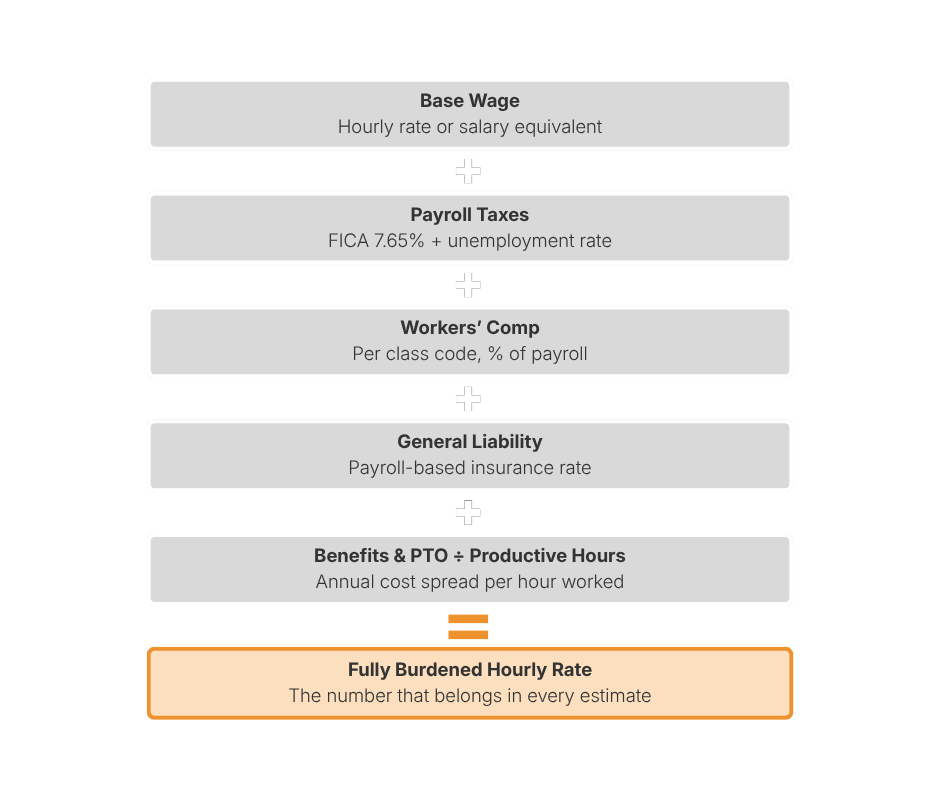 In a simple calculation, a carpenter at $30/hour might pick up roughly $2.30 in FICA, $0.75 in unemployment taxes, $4.50 in workers' comp at a framing class rate, $1.20 in general liability, and $2.75 in allocated benefits and PTO — landing at $41.50/hour. That's a 38% burden, squarely in the normal range, on an hour that most estimates would have carried at $30.
An $11.50 difference per hour sounds survivable. So let's watch what it does to an actual week.
One Crew, One Week:
Where the Labor Money Actually Goes
Picture a four-man framing crew on a straightforward residential job. Bid clean, no change orders, weather cooperating. By Friday the walls are up and plumb, right on schedule. On paper, a profitable week.
Here's the labor line the way the estimate carried it—real wages, honest math:
Weekly Labor Cost without Labor Burden
| Crew | Rate | Hours | Total |
|---|---|---|---|
| Lead framer | $30/hr | 40 | $1,200 |
| Framer | $26/hr | 40 | $1,040 |
| Framer | $26/hr | 40 | $1,040 |
| Laborer | $19/hr | 40 | $760 |
| Week total | 160 | $4,040 | |
Nobody padded anything, and nobody got lazy. Those are the wages those four men earn. But run each of them through the burden calculation above, and the same week looks like this from the accounting side of the office—
Weekly Labor Cost with Labor Burden
| Crew | Wage rate | Burdened rate | Hours | Actual cost |
|---|---|---|---|---|
| Lead framer | $30 | $41.50 | 40 | $1,660 |
| Framer | $26 | $35.90 | 40 | $1,436 |
| Framer | $26 | $35.90 | 40 | $1,436 |
| Laborer | $19 | $26.40 | 40 | $1,056 |
| Week total | 160 | $5,588 | ||
Estimated: $4,040. Actual: $5,588. The gap is $1,548—for one crew, in one week, on a job where everything went right.
Now stretch it out. A typical residential frame runs three to four weeks of crew time: that's $4,600 to $6,200 the estimate never carried. Frame six or eight jobs a year, and you're looking at $30,000 to $50,000 that showed up in payroll but never showed up in a bid. The money didn't disappear—it came out of margin, quietly and evenly, on every job. And because there's no single bad week to point to, no blown line item, no sub to argue with, nothing ever gets caught. The jobs just consistently close a little thinner than they were bid, until thin starts to feel normal.
Worth saying plainly: the crew did nothing wrong. The estimator wasn't careless—he used real wages. The week simply cost what weeks cost. The only question is whether the numbers knew it.
Why the Gap Survives:
The Numbers Live in Different Rooms
If the fix were as simple as "know your burden," every builder would have fixed it years ago. The reason the gap survives is structural.
Wage rates live in payroll. The estimate lives in the estimating file, built from the rates that were easiest to grab. Actual job costs live in the accounting system, coded to categories set up years ago. Each number is correct in its own room—and reconciling them is a manual spreadsheet project: export payroll, allocate burden, map hours back to jobs, compare against estimate lines. It's homework about the past, and it always loses to the three active jobs that need attention today.
This isn't a discipline problem. It's a plumbing problem—and plumbing problems have plumbing solutions.
How to Keep Labor Costs Under Control
The builders who hold labor margin tend to do a handful of things consistently, and none of them require becoming an accountant.
Bid with burdened rates, always.
Once true rates are calculated, they should be the only labor rates that ever touch an estimate. A bid built on wage rates isn't conservative—it may understate labor costs by 30–45% on any given labor hour.
Track labor to the job, not just to payroll.
Payroll tells you what you spent on people; only job-level tracking tells you what each project spent on people. Time tracked against jobs and cost codes is the raw material for every other improvement on this list.
Compare actuals against the estimate while the job is running.
A labor overrun discovered at closeout is a history lesson. The same overrun spotted in week two is a decision point—adjust the crew, revisit the schedule, or price the lesson into the next bid.
Review rates on a schedule.
Wages move, comp rates change at renewal, benefits costs climb. A burdened rate calculated once and trusted forever quietly drifts back toward fiction. Recalculate at least annually, and any time payroll or policies change.
Watch overtime like a cost, not a schedule tool.
Sometimes the deadline math justifies it. But overtime priced at a wage rate understates its true cost twice — once on the missing burden, once on the premium.
Connecting Pay Rates to Project Financials
Everything above gets dramatically easier when the burdened rate—not the wage rate—is the number that flows through estimating, scheduling, and job costing automatically, so accuracy stops depending on someone remembering to do spreadsheet homework.
That's the thinking behind the new labor cost tracking tools in ConstructionOnline. With Pay Rates, companies set each employee's true hourly cost once—wage plus the real burden behind it—with permission controls that keep sensitive pay information limited to the people who need it. From there, Labor Expenses carries those rates through time tracked on the job, so labor actuals land against the project in real dollars, ready to compare against the estimate while the job is still running—not six months after it closes.
For the framing crew above, that means the estimate would have carried $5,588 for the week, the bid would have priced it, and Friday afternoon would have been exactly as profitable as it looked.
Construction Labor Cost FAQs
What percentage of construction cost is labor?
For self-performed work, labor commonly runs 30–50% of total project cost, varying by trade, project type, and how much work is subcontracted. For GCs who sub most trades, direct labor is a smaller share — but labor cost is still embedded in every sub's price.
What is labor burden in construction?
Labor burden is the set of employer-paid costs beyond wages: payroll taxes, workers' compensation, liability insurance, benefits, and paid time off. For construction field labor, burden typically adds 30–45% on top of the base wage.
How do you calculate the true cost of a construction employee?
Start with the base wage, add 7.65% for employer FICA plus unemployment taxes, add workers' comp and general liability at your policy rates, then allocate annual benefits and PTO costs across expected productive hours. The total is the fully burdened hourly rate.
Do you pay labor burden on subcontractors?
No. Subcontractors carry their own payroll taxes, insurance, and benefits, priced into their quote. Their invoice is your cost—though GCs should collect certificates of insurance from every sub, since uninsured sub labor can end up on the GC's workers' comp audit.
Why do labor costs go over budget in construction?
The most common causes are estimates built on wage rates instead of burdened rates, unplanned overtime, untracked indirect labor, and the absence of job-level tracking that would surface overruns while there's still time to respond.