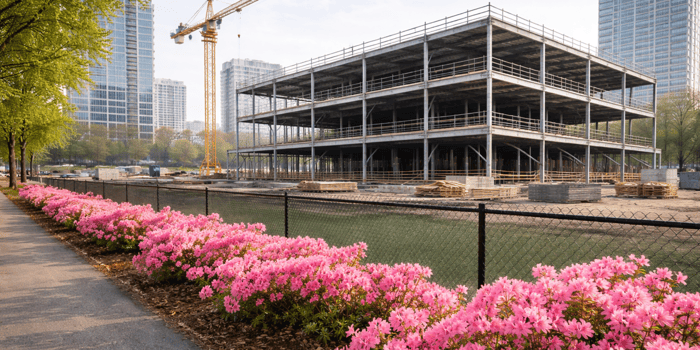
April showers bring May flowers. Ask a contractor what April brings and the answer is less poetic.
A full spring pipeline looks like a solved problem after a slow winter. Everything on paper points toward a strong quarter.
The backlog looks full... the account says otherwise.
Construction cash flow doesn't follow the logic of a busy backlog. The work and money move on different schedules, and April is when the gap gets expensive.
This time last year, Dodge Construction Network reported a 9% drop in total construction starts, not from weather, but linked to tariff uncertainty that arrived right as projects were expected to break ground. Work that had already been staffed and priced held, leaving costs committed against revenue that hadn't materialized.
The spring rebound most pipelines were built around turned out to be conditional. A difficult April has a way of showing exactly which businesses could see the strain before it arrived.
1. You're Paying for Work Weeks Before You Can Bill for It
Six to eight weeks. That's how long a contractor can be into a job before the first dollar arrives.
Mobilization out, materials ordered, subcontractors on site, and nothing yet received. The payment application hasn't been submitted, let alone reviewed and approved.
That delay is built into how construction works. It just gets more expensive when several jobs hit that same phase at once.
Spring compresses that timing. Costs stack early while billing lags behind.
How to fix it:
Billing needs to be built alongside the work, not assembled after it. The longer it takes to pull a submission together, the longer you're carrying costs without revenue.
2. Small Errors in Payment Applications Reset the Clock
A payment application isn't a request for payment the way a standard invoice is. It's a document that has to survive review before it releases funds.
When it comes back for corrections, the clock doesn't pause. It resets.
A disputed completion percentage or a missing lien waiver sends you back to the beginning of a cycle that was already running behind the work.
Construction payments research done by Rabbet in 2024 found that 92% of general contractors had work delayed or stopped because of slow payments. This pattern aligns with earlier findings from Levelset who reported that fewer than 40% of construction businesses get paid within 30 days despite most offering those terms. A lot of that gap is self-inflicted. Submissions that go out almost right come back weeks later for it.
How to fix it:
The errors that come back on pay apps usually trace to the gap between what's tracked and what's submitted. When the schedule of values, change orders, and progress tracking all come from the same system, the submission reflects the job as it actually exists. Fewer discrepancies means fewer resets.
3. Spring Volume Pushes Your Billing Process Past What It Can Handle
In the spring, more projects are billing at the same time. Each with its own documentation requirements and approval chain. Every reviewer has a different idea of what complete means.
A process that works fine on two active jobs starts slipping at five.
The draw on one job comes back with a disputed percentage on week three. The correction goes out on week four and clears on week six. Meanwhile, another job has a change order that wasn't reconciled with the base contract billing, so that goes back on week two and doesn't clear until week five. Neither one is a crisis, but together, they leave May with one partial receipt instead of two full ones, against subcontractor payments that were due on both jobs at the end of April.
The billing process wasn't built to handle that volume.
How to fix it:
The process breaks under volume when billing requires pulling information together at submission time. The less that has to be assembled in the moment, because it's already aligned in the system, the more jobs can move through the cycle without delays stacking on top of each other.
4. Approved Change Orders Aren't Reflected in Billing
This one tends to surface mid-review.
A change order is approved, but it doesn't make it into the billing correctly. Or it's tracked separately and never reconciled with the schedule of values before submission.
Now the numbers don't match the contract. The pay app comes back and the cycle starts over.
Meanwhile, the costs tied to that change order have already gone out.
The problem sits between where the change is tracked and where the billing is built.
How to fix it:
When changes are recorded in the same place billing is built, approved changes make it into the submission automatically instead of being reconciled after the fact. Tracked separately, they don't make it in correctly... or at all.
5. Delays on One Job Quietly Reshape Cash Across All Active Work
A cash flow disruption on one job doesn't stay contained.
A rejected draw on a job that just billed affects what's available when the subcontractor on a job further along needs to be paid. A billing delay on one contract reshapes the cash flow across everything running alongside it, and most of the time it only becomes visible after the impact is already in motion.
Seeing it early changes what's possible. When budget variances and schedule shifts are visible across all active projects before they compound, the response available is a conversation with a subcontractor about adjusted timing. When they surface after the fact, the response available is a credit line. Those are not the same decision, and the difference between them is usually a matter of days.
How to fix it:
The difference between a manageable delay and a cash problem is usually timing. Seeing how one job's billing slip affects the rest while there's still room to adjust changes what's possible. Once it shows up in the numbers, the options are already narrowed.
What It Adds Up To
The strain shows up when the billing process can't keep up with the work.
Submitting faster doesn't fix billing that comes back. And once delays start stacking across jobs, they don't stay isolated.
Spring doesn't create cash flow problems. It makes them visible.
When billing is built from the same data used to run the job, pay apps go out complete the first time. When you can see what's happening across projects as it's happening, delays don't build quietly.

That's what ConstructionOnline is built for—billing that moves with the work and visibility across every job while there's still time to act.
The flowers show up in May regardless. Whether the cash does is decided in April.