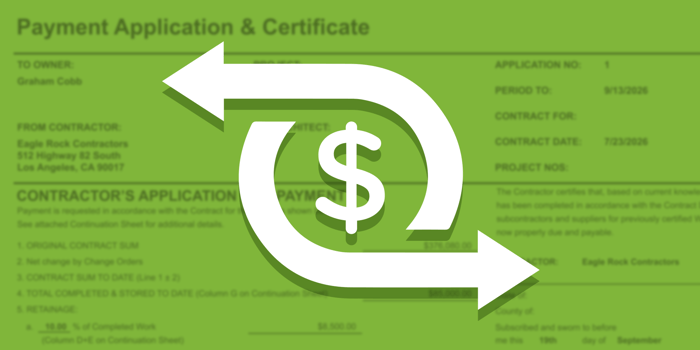
For construction professionals looking to reduce disputes, protect cash flow, and get paid on time.
If you've spent time in construction finance, you know that getting paid isn't just a matter of doing good work—it's a matter of documenting it correctly. Payment applications, or "pay apps," are the mechanism through which contractors request compensation for completed work. Done well, they keep projects moving and relationships intact. Done poorly, they invite delays, disputes, and cash flow headaches that can ripple across an entire project.
This guide breaks down everything you need to know about construction payment applications: what they are, what they must include, how to manage them effectively, and how modern technology is transforming the process.
What Is a Construction Payment Application — and Why Does It Matter?
A payment application is far more than a simple invoice. It's a structured, documented request for payment that captures the full financial picture of work performed during a specific billing period. Unlike a standard invoice, a pay app must substantiate every dollar claimed—tying labor, materials, and costs back to an approved schedule of values and contract terms.
This level of documentation exists for good reason. Construction projects involve multiple stakeholders—owners, general contractors, subcontractors, lenders, and sometimes architects or project managers—each with a financial interest in accuracy and transparency. A well-prepared payment application protects everyone: it gives contractors a clear path to payment and gives owners confidence that they're paying for work that's actually been completed.
Beyond individual transactions, payment applications are the financial backbone of a project. They create a documented trail of progress, costs, and approvals that can be essential during audits, disputes, or closeout.
Key Terminology Every Construction Professional Should Know
Miscommunication around payment terms is a leading cause of billing disputes. Here are the core terms you'll encounter in any payment application workflow:
-
Retainage: A percentage of each progress payment (typically 5-10%) that the owner withholds until project completion or a defined milestone. It serves as a performance incentive but can create significant cash flow pressure for contractors and subs.
- Schedule of Values (SOV): A line-by-line breakdown of the total contract value, allocating costs to specific scopes of work. The SOV is the backbone of every payment application, defining what will be billed and when.
- Progress Billing: The practice of submitting invoices incrementally as work is completed, rather than in a lump sum at the end. Most commercial contracts follow a monthly progress billing cycle.
- Lien Waiver: A legal document in which the contractor or subcontractor releases their right to file a mechanics lien for the amount being paid. Most GCs require lien waivers before releasing funds.
- Change Order: A formal amendment to the contract reflecting additions, deletions, or modifications to the original Scope of Work (SOW). Change orders affect the contract value and must be reflected accurately in subsequent payment applications.
- AIA G702 / G703: Industry-standard payment application forms published by the American Institute of Architects. The G702 is the cover summary; the G703 is the continuation sheet detailing individual line items.
Getting comfortable with this vocabulary—and ensuring your whole team uses it consistently—reduces friction at every step of the billing process.
What Every Complete Payment Application Should Include
A payment application that's missing information isn't just inconvenient — it delays your payment, sometimes by a full billing cycle. Here's what a complete pay app package should contain:
Core Application Components
- Project Identification: Project name, location, contract number, and the billing period covered by the payment application.
- Schedule of Values (SOV): An itemized breakdown of work, showing original contract amounts, work completed to date, work completed during the current billing period, materials stored on-site, retainage withheld, and the net amount due.
- Invoiced Amounts: The specific dollar figures being claimed, commonly broken into 3 subcategories—amounts invoiced this period (the current payment request), amounts invoiced to date (cumulative billings across all applications), and the balance to complete (remaining contract value not yet billed).
- Work Completed: A clear summary of progress made during the billing period, ideally supported by progress photos or field reports.
- Materials Stored: Documentation of materials delivered to the job site but not yet incorporated into the work. Many contracts allow billing for stored materials with proper documentation.
- Change Orders: Any owner-approved changes that affect the contract value or scope, clearly reflected in the billing documentation.
- Retainage Details: The percentage being withheld and the cumulative retainage balance.
- Lien Waivers: Conditional lien waivers for the current payment request (and unconditional waivers for previously paid amounts, if required).
- Required Signatures: Certification from the contractor, and where applicable, the architect or owner's representative.
Supporting Documentation
Depending on the contract, you may need to include additional supporting documentation, such as: certified payroll reports, proof of insurance, prevailing wage documentation (for public projects), subcontractor pay app copies, and vendor invoices for materials. Review each project's contract carefully—requirements vary significantly.
Best Practices for Managing Payment Applications
Knowing what to include is only half the battle. Consistently executing on it—across multiple projects, billing cycles, and team members—is where most firms struggle. These practices make a measurable difference:
1. Build a Submission Calendar
Most GCs publish a pay app schedule at the start of a project. Mark every deadline in your project calendar and work backward: if the cutoff is the 25th, your internal deadline might be the 20th to allow time for review, signatures, and corrections. Missing a deadline can push your payment to the next cycle—a 30-day delay that compounds quickly.
2. Keep Your SOV Honest and Defensible
Front-loading your schedule of values—assigning inflated values to early scope items to improve early cash flow—is a common temptation and a common problem. It erodes trust with owners and GCs, can trigger disputes, and may violate contract terms. An accurate, well-balanced SOV is a better long-term strategy.
3. Document as You Go
Don't wait until billing time to reconstruct what was completed. Daily logs, progress photos, delivery tickets, and field reports are far more credible—and easier to compile—when collected in real time. Build documentation habits into your project management process, not as an afterthought.
4. Conduct a Pre-Submission Review
Before every submission, verify that: the math across all SOV line items is correct, all change orders are reflected at their approved values, retainage percentages match the contract terms, and required supporting documents are attached. A quick checklist review at this stage can prevent a rejection that delays payment by weeks.
5. Follow Up Proactively
Submitting the application is not the end of your job. Confirm receipt, check the status at regular intervals, and address any review comments quickly. The contractors who get paid fastest are typically the ones who treat billing as an ongoing process, not a monthly event.
The Legal Framework of Pay Apps: What You Need to Know
Construction payment applications don't exist in a vacuum—they operate within a framework of contract terms, state statutes, and lien laws that vary by jurisdiction. Ignoring this framework can be costly.
Contract Terms
Every payment application should be read against the specific contract under which you're working. Key clauses to understand include: pay-when-paid and pay-if-paid provisions (which govern when a GC must pay subs), retainage release conditions, dispute resolution procedures, and notice requirements for change orders or claims.
Lien Rights
Mechanics liens are one of the most powerful tools available to contractors and subcontractors who haven't been paid. But lien rights are time-sensitive and highly state-specific—deadlines for preliminary notices, lien filings, and enforcement vary significantly. Understanding your lien rights in each state where you work is not optional; it's a basic component of financial protection.
Prompt Payment Statutes
Most states have prompt payment laws that establish maximum timeframes for paying down the construction payment chain. Familiarize yourself with the statutes in your state—they often provide for interest penalties and attorney's fees when payment is unreasonably delayed.
Technology's Role in Modernizing the Payment Application Process
For decades, payment applications were managed through a combination of spreadsheets, PDF forms, email chains, and manual data entry. That approach is still common—and it's expensive. Errors, duplicate work, missed deadlines, and lost documents are the predictable byproducts of manual processes at scale.
Construction financial management software and dedicated pay app platforms are changing this, and the adoption curve is accelerating. Here's what modern technology brings to the table:
Automation and Workflow Management
Purpose-built financial management software automates the creation, routing, tracking, and approval of payment applications. Automated workflows reduce manual data entry, flag discrepancies before submission, and create a clear audit trail for every application.
PM and Accounting Integration
The most effective platforms integrate directly with your construction project management and accounting software — including QuickBooks. This eliminates redundant data entry and ensures that payment application data flows seamlessly into your job cost accounting.
Real-Time Visibility
Cloud-based systems give owners, GCs, and other financial stakeholders up-to-date access to current application status, payment history, and outstanding balances. This transparency reduces the "where's my payment?" back-and-forth that consumes accounting and project management time.
Mobile Access
Field-based project managers can review, approve, or flag applications from any device — accelerating approval cycles that used to require office visits or scheduled meetings.
The business case for technology investment is straightforward: faster approvals, fewer errors, better compliance, and stronger cash flow. Firms that have made the transition typically report meaningful reductions in pay app cycle time and billing disputes.
Accurate Documentation: The Foundation of Successful Pay Apps
Technology helps, but documentation discipline is what ultimately determines whether a payment application gets approved on the first submission or sent back for corrections. The most sophisticated software in the world can't compensate for missing field data, unsigned change orders, or mismatched figures.
Think of your documentation infrastructure as three interconnected systems:
- Progress Tracking: Regular site reports, percent-complete assessments by scope, and progress photography that substantiate the claimed billing percentages.
- Cost Documentation: Material delivery tickets, subcontractor invoices, equipment rental records, and labor hours that support every dollar of the application.
- Change Management: A rigorous process for capturing, pricing, and obtaining approval for scope changes before they're billed. Billing for unapproved change orders is one of the fastest ways to damage a GC relationship.
When your documentation is thorough and organized, payment applications become straightforward rather than stressful — and disputes, when they do arise, are resolved quickly because the evidence is already in hand.
Key Takeaways
Mastering payment applications isn't glamorous work, but it's among the highest-leverage activities in construction financial management. Here's what the best firms consistently get right:
-
Treat pay apps as a system, not a monthly chore. Build submission calendars, pre-submission checklists, and documentation habits into your standard operating procedures.
- Know your contracts and your rights. Payment applications operate within a legal framework—understand it, or engage with advisors who do.
- Invest in the right technology. Manual processes at scale are a liability. Modern construction software and key integrations reduce errors, accelerate approvals, and improve cash flow predictability.
- Document continuously, not retroactively. The credibility of your billing is built in the field, every day—not in the accounting office the week before cutoff.
- Communicate proactively. The contractors who get paid fastest are the ones who treat billing as a relationship and a process, not just a transaction.
Construction is a demanding business. Your payment application process doesn't have to add to that difficulty—with the right systems, practices, and tools, it can be one of the most reliable parts of your operations.
Frequently Asked Questions
What is a construction payment application, and how is it different from an invoice?
A payment application is a comprehensive, documented request for payment that substantiates the work completed during a specific billing period against an approved schedule of values. Unlike a standard invoice, it must include detailed backup—SOV line items, change orders, lien waivers, and supporting documentation—that allows the paying party to verify what's being billed. It's more structured and more evidence-based than a typical invoice.
What are the most common reasons payment applications get rejected?
The most frequent causes are: missing or incorrectly completed lien waivers, math errors in the SOV, billing for unapproved change orders, missing supporting documentation (payroll, delivery tickets, insurance certificates), and submission after the GC's deadline. A pre-submission checklist is the simplest way to catch these issues before they cost you a billing cycle.
What is retainage, and how does it affect cash flow?
Retainage is the percentage of each progress payment (typically 5–10%) that an owner withholds as a performance incentive until substantial completion or another contractual milestone. For contractors and subcontractors, it represents real working capital that's tied up for months or years. Managing retainage—tracking the balance, negotiating favorable release terms, and planning around it—is a core component of construction cash flow management.
How do I handle change orders in a payment application?
Only bill for change orders that have been formally approved and executed. When you submit a pay app, the SOV should reflect the adjusted contract value including all approved changes. Supporting documentation—the signed change order and any backup pricing—should be included with the application. Billing for unapproved changes, even if you're confident they'll be approved eventually, typically results in rejection and can strain your relationship with the GC or owner.
What technology should I consider for managing payment applications?
The right answer depends on your firm's size, project complexity, and existing systems. At minimum, most firms benefit from cloud-based financial management software that automates invoicing, change order management, pay app creation, and approval tracking. Larger firms typically look for integrated construction management platforms that include financial tools, alongside project planning, resource management, progress tracking, and accounting integration. Key features to evaluate: connected workflows, accounting integration, compliance tracking, mobile access, and real-time reporting.
What legal protections do I have if I'm not paid on time?
Your primary protections are mechanics lien rights, prompt payment statutes, and your contract's dispute resolution provisions. Lien rights allow you to encumber the property as security for unpaid amounts—but they're governed by strict state-specific deadlines for preliminary notices, lien filings, and enforcement. Prompt payment laws establish maximum payment timeframes and often provide interest and fee remedies for violations. If you're regularly experiencing payment delays or disputes, consult a construction attorney in your jurisdiction.
Streamlining Payment Applications with ConstructionOnline
Understanding construction payment applications is only part of the equation. Executing them consistently—across projects, billing cycles, and stakeholders—is where many teams encounter friction. As this guide has outlined, even small gaps in documentation, coordination, or timing can delay approvals and disrupt cash flow.
This is where purpose-built construction financial management software becomes especially valuable.
ConstructionOnline’s Payment Applications feature is designed to bring structure and clarity to the entire process. By connecting your schedule of values, change orders, and cost data within a single system, teams can generate accurate construction payment applications more efficiently while maintaining alignment between project management and accounting. The system also supports industry-standard documentation, including compatibility with AIA G702 and G703 forms, helping ensure that submissions meet common contractual and compliance requirements.
Instead of relying on spreadsheets, email chains, and disconnected tools, teams gain a centralized workflow for creating, tracking, and reviewing payment applications. This not only reduces the risk of errors and omissions, but also improves visibility for everyone involved—from project managers in the field to financial stakeholders reviewing progress.
As projects scale and billing complexity increases, having a consistent system in place helps ensure that construction payment applications remain accurate, timely, and defensible—supporting stronger relationships and more predictable cash flow.