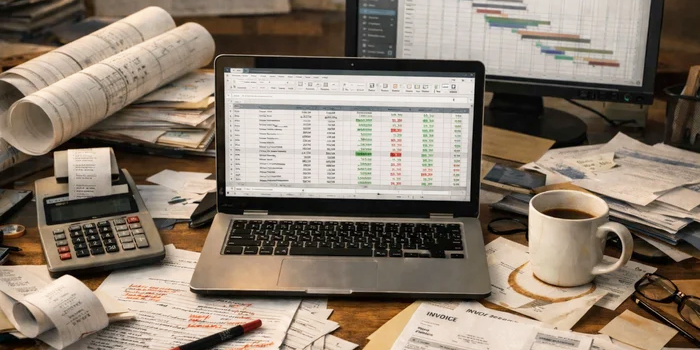
At some point, every growing contractor feels it. The system that worked for the business they had starts slipping against the one they're running now. Most notice it before they can name it.
The billing workflow had been stable for a decade until the contract structure changed.
New scope. A different scale entirely.
And somewhere in the middle of adjusting to it, a spreadsheet appeared. That spreadsheet is usually one of the first signs you've outgrown your construction management software.
The spreadsheet starts as a quick reference and slowly becomes the source everyone trusts more than the system itself—a document nobody planned on building and now can't seem to work without.
For a long time, that was good enough.
Until the work outgrew the system.
When the Market Tightens, Weak Systems Get Exposed
Credit conditions for residential construction tightened for sixteen consecutive quarters. Long enough that it stopped feeling like a short-term adjustment and more like the new normal.
Work that used to move on a handshake started requiring documentation that actually held up. The margin for administrative friction, the kind that comes from cobbled-together software, got thinner with every quarter.
For many contractors, that shift exposed the systems behind their work. The lending environment didn't create that complexity, but it did make it harder to pretend it wasn't there.
What Are the Signs You've Outgrown Your Construction Management Software?
They don't arrive all at once.
It's the extra half-hour to pull job cost numbers together because they live in three places instead of one. Documentation that held up fine in front of a client or lender a year ago now needing more explanation than it should.
No contractor sets out to build workarounds for a patchwork of tools. It happens the way most things do in construction. One decision at a time, each reasonable when it was made.
A scheduling tool gets added. Accounting moves to something better suited for financial reporting. Files move to the cloud once the projects become complicated enough to demand it.
Before long, that collection of tools becomes the system. Getting a clear picture of a project means juggling tabs between platforms until the numbers finally agree. And one of those tabs is usually that spreadsheet.
At lower volumes, that arrangement mostly works. It's manageable friction. A tax on a few afternoons that you absorb without thinking about it.
At higher volumes, though, good enough stops being either.
You start noticing how much translation is happening behind the scenes, and how normal it's started to feel. Numbers copied into spreadsheets, manually reconciled across systems, reformatted into something a client or lender can actually read.
A project that's running well in the field starts to look unfinished on paper. The work is getting done, but the way it's presented doesn't hold up the way it used to. A client reviews what was sent and something doesn't quite land.
Sometimes it's just a question that takes longer than it should. How are we tracking against budget? Where does the schedule stand? Questions that shouldn't take two people, several systems, and half a morning to answer.
Why Growing Contractors Keep Patching the System
"That's the way we've always done it" makes replacing software feel like a bigger move than it should.
Patching feels manageable because you know where the tape holds and where it doesn't. There's something almost comforting about a problem you've already learned to live with. The workaround is frustrating, but it's familiar.
A new system carries a different kind of uncertainty—the learning curve, migration, conversations with the team about why everything is changing.
So the patch gets another seam.
But there's a moment when the system that helped you climb starts getting in the way. Not because it broke, but because it was built for a different version of the company.
As the work grows, the seams start to show. The manual reconciliation that used to be one person's Tuesday afternoon becomes a standing item on the weekly agenda. The spreadsheet nobody planned on building becomes the thing new hires get trained on.
At which point, if we're being honest, we should stop calling it a workaround.
That's the business.
What to Look for in Construction Management Software
When contractors start evaluating construction management software, the conversation usually begins with features.
But what matters more than any individual feature is whether they're all working from the same information.
In a patchwork system, information is always moving. Numbers copied from one tool into another. Files exported, updated, then passed along to the rest of the team. Every update asks someone to do a small piece of translation work before anything can move forward.
Integrated construction management software removes most of that movement. When something changes, everything else changes with it.
Which sounds small until you've spent enough time reconciling systems to know how much work that translation creates.
ConstructionOnline™ is built around one idea: project information shouldn't have to travel.
Estimates, change orders, purchase orders, and invoices all pull from the same financial toolkit, so no one is rebuilding the financial picture at the end of the month.
The schedule reflects the same project the budget is tracking. Deadlines, walkthroughs, and punch list items aren't living in separate tools or someone's memory. The team is working from the same timeline, whether they're in the field or in the office.
And when an owner asks where things stand, the answer is already there—in a form that holds up.
For growing contractors, that shift feels less like adding another standalone tool and more like removing the work that had accumulated around the old ones.
The signs were always there.
The market just made them harder to hide.
 Your seams might be showing.
Schedule a free demo to see how
ConstructionOnline is built to scale with you.